AI-102認証資格、AI-102日本語版参考書
Wiki Article
無料でクラウドストレージから最新のJpexam AI-102 PDFダンプをダウンロードする:https://drive.google.com/open?id=1ipIREwlrEA6rbVFLVBB-GS809qnTXxyc
多くの受験者は、AI-102試験に合格するための準備で困難に直面しています。しかし、当社の教材は、受験者が試験に簡単に合格するのに役立ちます。 AI-102ガイドの質問は、Microsoft学習者が脆弱なリンクを見つけて対処するのに役立つ統計レポート機能を提供できます。 AI-102テストトレントは、タイミングの機能と試験のシミュレーションを強化します。タイマーを設定して試験をシミュレートし、学習者が速度を調整してアラートを維持できるようにします。 AI-102ガイドの質問は、学習者が試験をマスターして合格するのに非常に便利です。
Microsoft AI-102認定を取得することで、候補者のAzureプラットフォーム上でのAIソリューションの設計と実装の専門知識が検証されます。この認定は、Azureサービスを活用してデータ主導の意思決定を支援する知的ソリューションを作成する能力を示すこともできます。さらに、この認定を取得することで、技術産業の最も急速に成長している分野の一つにおいて、専門能力を証明することでキャリアアップを図ることができます。
Microsoft AI-102試験に合格するためには、機械学習モデル、データ準備、特徴量エンジニアリング、モデルの選択など、AIの基礎について深い理解が必要です。また、AzureでAIソリューションを設計・実装する実践的な経験が必要であり、モデルのデプロイ、パフォーマンスのモニタリング、問題のトラブルシューティングも行える必要があります。
AI-102日本語版参考書 & AI-102復習教材
Jpexamは、AI-102の実際のテストの品質を非常に重視しています。 すべての製品は厳格な検査プロセスを受けます。 さらに、さまざまな種類のAI-102学習資料間でランダムチェックが行われます。 AI-102学習教材の品質はあなたの信頼に値します。 試験を準備するための最も重要なことは、重要なポイントを確認することです。 優れたAI-102試験問題により、合格率は他の受験者よりもはるかに高くなっています。 AI-102のDesigning and Implementing a copyright AI Solution試験の準備にはショートカットがあります。
Microsoft AI-102(copyright AIソリューションの設計と実装)は、copyrightを使用してAIソリューションの設計と実装のスキルを実証したい専門家向けに設計された認定試験です。この認定試験は、Azure Servicesを使用してAIソリューションの実装を経験したAIエンジニア、データサイエンティスト、および開発者を対象としています。この試験では、ビジネス要件を満たし、他のAzureサービスと統合するAIソリューションを設計および実装する候補者の能力を測定します。
Microsoft Designing and Implementing a copyright AI Solution 認定 AI-102 試験問題 (Q194-Q199):
質問 # 194
You are developing an internet-based training solution for remote learners.
Your company identifies that during the training, some learners leave their desk for long periods or become distracted.
You need to use a video and audio feed from each learner's computer to detect whether the learner is present and paying attention. The solution must minimize development effort and identify each learner.
Which Azure Cognitive Services service should you use for each requirement? To answer, select the appropriate options in the answer area.
NOTE: Each correct selection is worth one point.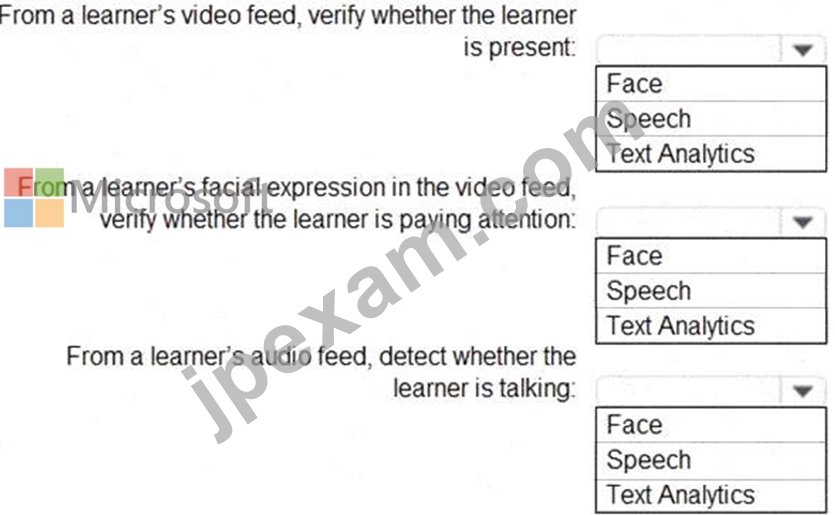
正解:
解説: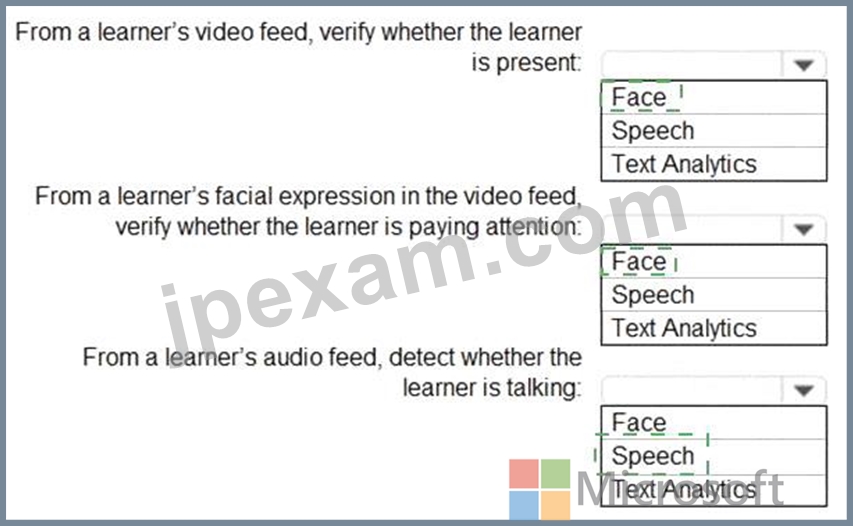
Explanation: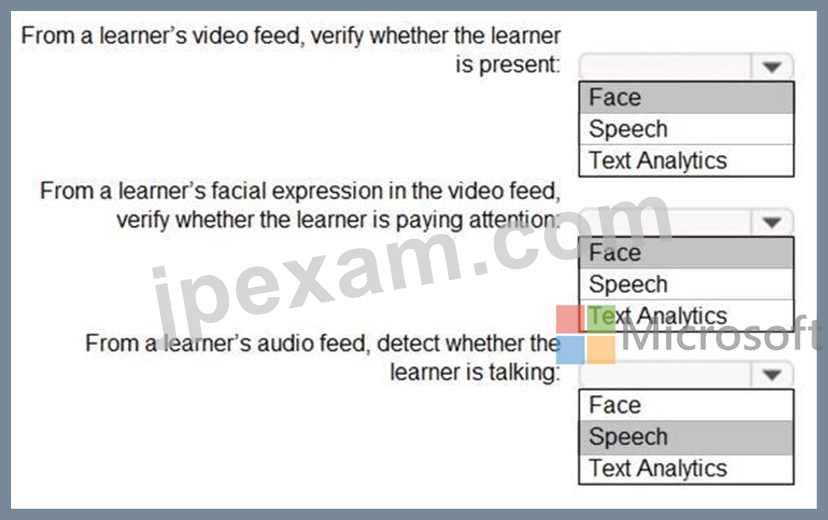
Reference:
https://docs.microsoft.com/en-us/azure/cognitive-services/what-are-cognitive-services
質問 # 195
Case Study 1 - Wide World Importers
Overview
Existing Environment
A company named Wide World Importers is developing an e-commerce platform.
You are working with a solutions architect to design and implement the features of the e- commerce platform. The platform will use microservices and a serverless environment built on Azure.
Wide World Importers has a customer base that includes English, Spanish, and Portuguese speakers.
Applications
Wide World Importers has an App Service plan that contains the web apps shown in the following table.
Azure Resources
You have the following resources:
* An Azure Active Directory (Azure AD) tenant
- The tenant supports internal authentication.
- All employees belong to a group named AllUsers.
- Senior managers belong to a group named LeadershipTeam.
* An Azure Functions resource
- A function app posts to Azure Event Grid when stock levels of a product change between OK, Low Stock, and Out of Stock. The function app uses the Azure Cosmos DB change feed.
* An Azure Cosmos DB account
- The account uses the Core (SQL) API.
- The account stores data for the Product Management app and the Inventory Tracking app.
* An Azure Storage account
- The account contains blob containers for assets related to products.
- The assets include images, videos, and PDFs.
* An Azure AI Services resource named wwics
* An Azure Video Analyzer for Media (previously Video Indexer) resource named wwivi
Requirements
Business Goals
Wide World Importers wants to leverage AI technologies to differentiate itself from its competitors.
Planned Changes
Wide World Importers plans to start the following projects:
* A product creation project: Help employees create accessible and multilingual product entries,
while expediting product entry creation.
* A smart e-commerce project: Implement an Azure AI Search solution to display products for
customers to browse.
* A shopping on-the-go project: Build a chatbot that can be integrated into smart speakers to
support customers.
Business Requirements
Wide World Importers identifies the following business requirements for all the projects:
* Provide a multilingual customer experience that supports English, Spanish, and Portuguese.
* Whenever possible, scale based on transaction volumes to ensure consistent performance.
* Minimize costs.
Governance and Security Requirements
Wide World Importers identifies the following governance and security requirements:
* Data storage and processing must occur in datacenters located in the United States.
* Azure AI Services must be inaccessible directly from the internet.
Accessibility Requirements
Wide World Importers identifies the following accessibility requirements:
* All images must have relevant alt text.
* All videos must have transcripts that are associated to the video and included in product
descriptions.
* Product descriptions, transcripts, and all text must be available in English, Spanish, and
Portuguese.
Product Creation Requirements
Wide World Importers identifies the following requirements for improving the Product Management app:
* Minimize how long it takes for employees to create products and add assets.
* Remove the need for manual translations.
Smart E-Commerce Requirements
Wide World Importers identifies the following requirements for the smart e-commerce project:
* Ensure that the Azure AI Search solution meets a Service Level Agreement (SLA) of 99.9%
availability for searches and index writes.
* Provide users with the ability to search insight gained from the images, manuals, and videos
associated with the products.
* Support autocompletion and autosuggestion based on all product name variants.
* Store all raw insight data that was generated, so the data can be processed later.
* Update the stock level field in the product index immediately upon changes.
* Update the product index hourly.
Shopping On-the-Go Requirements
Wide World Importers identifies the following requirements for the shopping on-the-go chatbot:
* Answer common questions.
* Support interactions in English, Spanish, and Portuguese.
* Replace an existing FAQ process so that all Q&A is managed from a central location.
* Provide all employees with the ability to edit Q&As. Only senior managers must be able to
publish updates.
* Support purchases by providing information about relevant products to customers. Product
displays must include images and warnings when stock levels are low or out of stock.
Product JSON Sample
You have the following JSON sample for a product.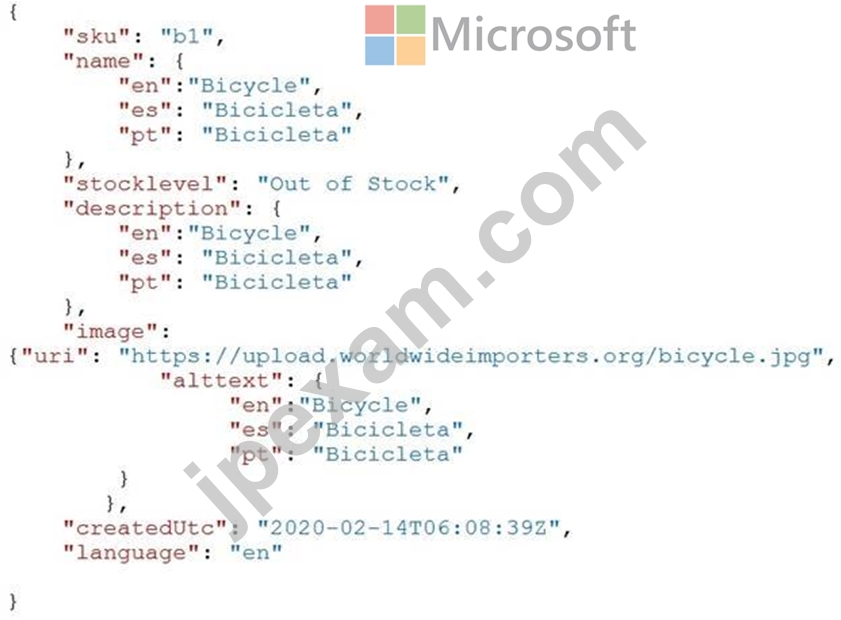
Hotspot Question
You need to develop code to upload images for the product creation project. The solution must meet the accessibility requirements.
How should you complete the code? To answer, select the appropriate options in the answer area.
NOTE: Each correct selection is worth one point.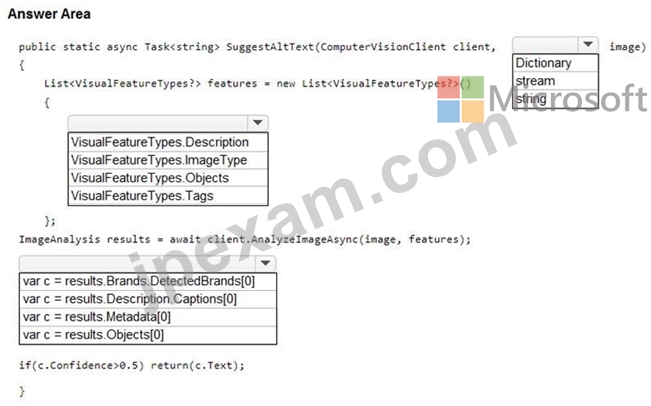
正解:
解説: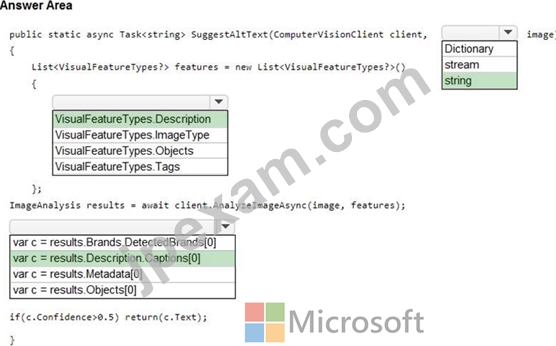
質問 # 196
You need to build an app that will use the Azure Al Speech service to translate audio files.
How should you complete the code? To answer, select the appropriate options in the answer area.
NOTE: Each correct selection is worth one point.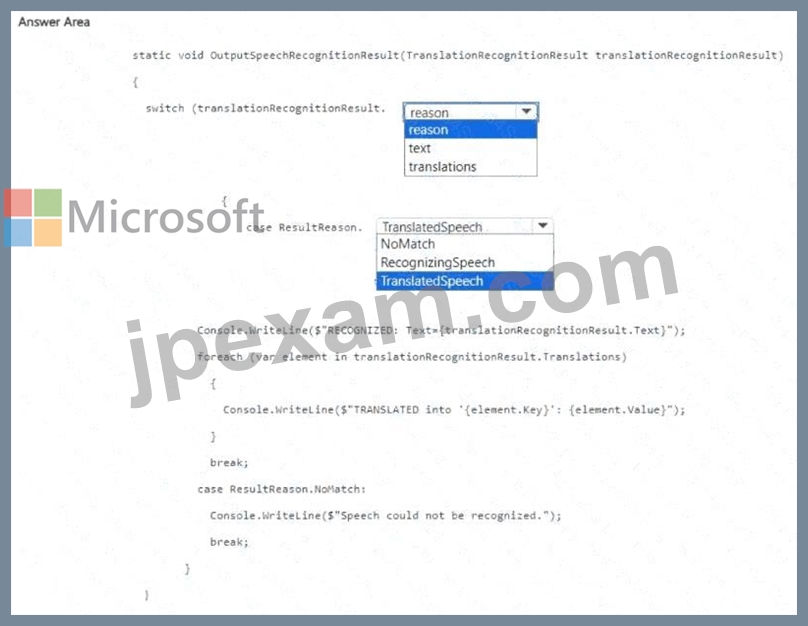
正解:
解説: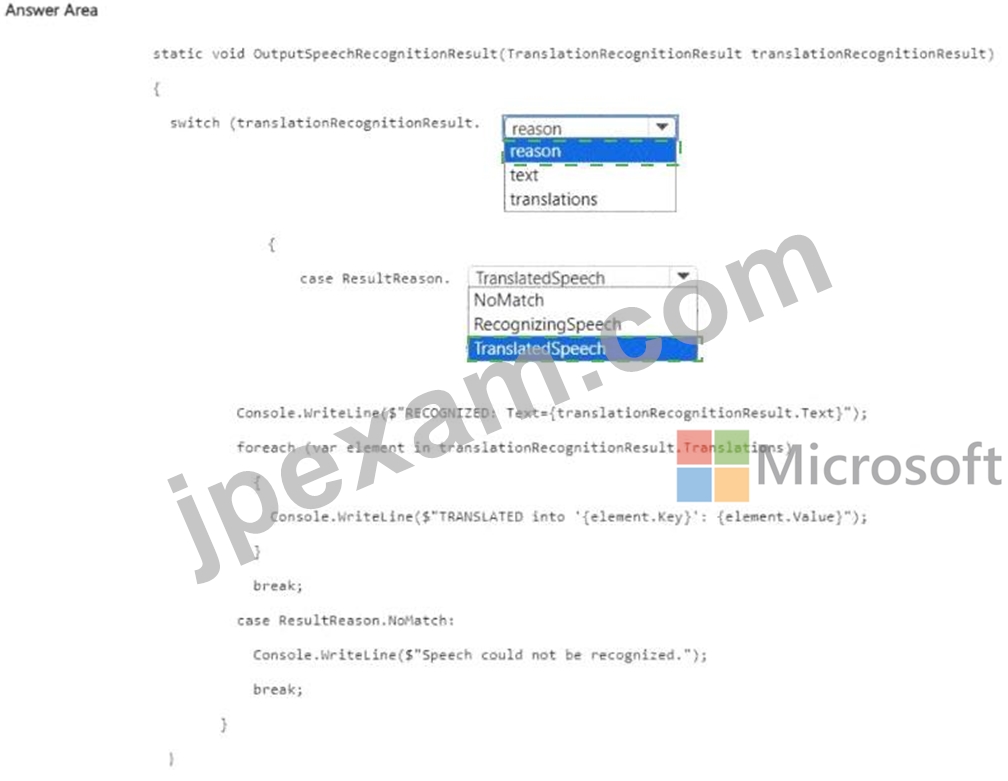
Explanation: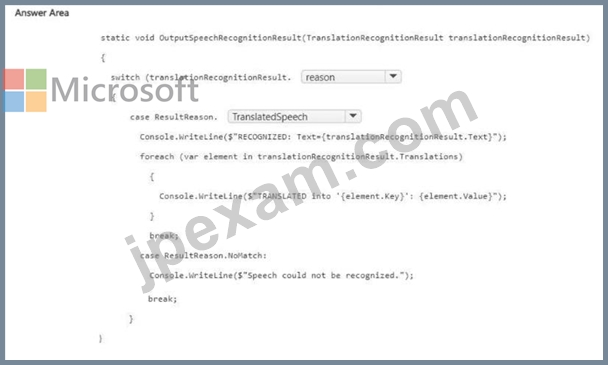
When using the Speech SDK's speech translation, a TranslationRecognitionResult includes a Reason property (type ResultReason) indicating the outcome. For successful translation results, the reason is ResultReason.TranslatedSpeech. In that case, you can read the recognized source text from translationRecognitionResult.Text and iterate the translated outputs from translationRecognitionResult.
Translations (a dictionary keyed by target language code).
RecognizingSpeech corresponds to interim hypotheses raised on the Recognizing event and is not the final result reason used here; NoMatch is the branch already handled for unrecognized audio.
copyright AI References
* Azure AI Speech SDK - Speech translation overview and TranslationRecognizer usage (C#): result handling with ResultReason.TranslatedSpeech, reading Text and Translations.
* Speech SDK API reference - TranslationRecognitionResult (Reason, Text, Translations) and ResultReason enum (values include TranslatedSpeech, NoMatch, Canceled).
質問 # 197
You have an app that manages feedback.
You need to ensure that the app can detect negative comments by using the Sentiment Analysis API in Azure Cognitive Service for Language. The solution must ensure that the managed feedback remains on your company's internal network.
Which three actions should you perform in sequence? To answer, move the appropriate actions from the list of actions to the answer area and arrange them in the correct order.
NOTE: More than one order of answer choices is correct You will receive credit for any of the correct orders you select.
正解:
解説:
Explanation:
Provision the Language service resource in Azure.
Deploy a Docker container to an on-premises server.
Run the container and query the prediction endpoint.
According to the Microsoft documentation, the Language service is a cloud-based service that provides various natural language processing features, such as sentiment analysis, key phrase extraction, named entity recognition, etc. You can provision the Language service resource in Azure by following the steps in Create a Language resource. You will need to provide a name, a subscription, a resource group, a region, and a pricing tier for your resource. You will also get a key and an endpoint for your resource, which you will use to authenticate your requests to the Language service API.
According to the Microsoft documentation, you can also use the Language service as a container on your own premises or in another cloud. This option gives you more control over your data and network, and allows you to use the Language service without an internet connection. You can deploy a Docker container to an on- premises server by following the steps in Deploy Language containers. You will need to have Docker installed on your server, pull the container image from the Microsoft Container Registry, and run the container with the appropriate parameters. You will also need to activate your container with your key and endpoint from your Azure resource.
According
to the Microsoft documentation, once you have deployed and activated your container, you can run it and query the prediction endpoint to get sentiment analysis results. The prediction endpoint is a local URL that follows this format: http://
<container IP address>:<port>/text/analytics/v3.1-preview.4/sentiment. You can send HTTP POST requests to this endpoint with your text input in JSON format, and receive JSON responses with sentiment labels and scores for each document and sentence in your input.
質問 # 198
You build a conversational bot named bot1.
You need to configure the bot to use a QnA Maker application.
From the Azure Portal, where can you find the information required by bot1 to connect to the QnA Maker application?
- A. Identity
- B. Keys and Endpoint
- C. Properties
- D. Access control (IAM)
正解:B
解説:
Explanation
Obtain values to connect your bot to the knowledge base
1.In the QnA Maker site, select your knowledge base.
2.With your knowledge base open, select the SETTINGS tab. Record the value shown for service name. This value is useful for finding your knowledge base of interest when using the QnA Maker portal interface. It's not used to connect your bot app to this knowledge base.
3.Scroll down to find Deployment details and record the following values from the Postman sample HTTP request:
4.POST /knowledgebases/<knowledge-base-id>/generateAnswer
5.Host: <your-host-url>
6.Authorization: EndpointKey <your-endpoint-key>
Reference:
https://docs.microsoft.com/en-us/azure/bot-service/bot-builder-howto-qna
質問 # 199
......
AI-102日本語版参考書: https://www.jpexam.com/AI-102_exam.html
- コンプリートAI-102認証資格 | 素晴らしい合格率のAI-102: Designing and Implementing a copyright AI Solution | 信頼的なAI-102日本語版参考書 ???? ▶ www.it-copyright.com ◀で▛ AI-102 ▟を検索して、無料で簡単にダウンロードできますAI-102合格率
- ユニークなAI-102認証資格 - 合格スムーズAI-102日本語版参考書 | 有難いAI-102復習教材 ???? 「 AI-102 」の試験問題は✔ www.goshiken.com ️✔️で無料配信中AI-102コンポーネント
- AI-102復習時間 ???? AI-102試験関連赤本 ???? AI-102合格率 ???? サイト☀ www.copyright.jp ️☀️で[ AI-102 ]問題集をダウンロードAI-102合格率
- AI-102英語版 ???? AI-102日本語版サンプル ???? AI-102資格トレーニング ???? ⇛ www.goshiken.com ⇚で{ AI-102 }を検索して、無料で簡単にダウンロードできますAI-102復習時間
- AI-102日本語版サンプル ???? AI-102認証pdf資料 ???? AI-102コンポーネント ???? ➥ www.it-copyright.com ????サイトで➠ AI-102 ????の最新問題が使えるAI-102真実試験
- 実際的Microsoft AI-102|素敵なAI-102認証資格試験|試験の準備方法Designing and Implementing a copyright AI Solution日本語版参考書 ???? ウェブサイト[ www.goshiken.com ]から▷ AI-102 ◁を開いて検索し、無料でダウンロードしてくださいAI-102認証pdf資料
- AI-102コンポーネント ???? AI-102日本語 ☎ AI-102日本語版サンプル ✊ ⇛ www.xhs1991.com ⇚から“ AI-102 ”を検索して、試験資料を無料でダウンロードしてくださいAI-102資格トレーリング
- 100%合格率のAI-102認証資格 - 合格スムーズAI-102日本語版参考書 | 便利なAI-102復習教材 ???? ➠ www.goshiken.com ????に移動し、【 AI-102 】を検索して無料でダウンロードしてくださいAI-102日本語
- AI-102試験概要 ???? AI-102資格トレーリング ???? AI-102英語版 ???? Open Webサイト➽ www.mogiexam.com ????検索▶ AI-102 ◀無料ダウンロードAI-102コンポーネント
- AI-102試験関連赤本 ???? AI-102日本語 ???? AI-102認証pdf資料 ???? 【 www.goshiken.com 】に移動し、▷ AI-102 ◁を検索して、無料でダウンロード可能な試験資料を探しますAI-102コンポーネント
- 100%合格率のAI-102認証資格 - 合格スムーズAI-102日本語版参考書 | 便利なAI-102復習教材 ???? { www.copyright.jp }を開き、⮆ AI-102 ⮄を入力して、無料でダウンロードしてくださいAI-102試験内容
- ezekieldanz196145.nizarblog.com, aishadkwn266198.wikiexcerpt.com, xandertttc757016.shivawiki.com, bookmarkingdelta.com, singnalsocial.com, bookmarkgenious.com, deaconzchp475568.vblogetin.com, social-lyft.com, flynnnryz880376.evawiki.com, nevenwod237124.thebindingwiki.com, Disposable vapes
無料でクラウドストレージから最新のJpexam AI-102 PDFダンプをダウンロードする:https://drive.google.com/open?id=1ipIREwlrEA6rbVFLVBB-GS809qnTXxyc
Report this wiki page